
The Execution Challenge: Why Vision Fails Without the Right (AI) Productization Discipline
Dmitry Borodin
10/16/20252 min read
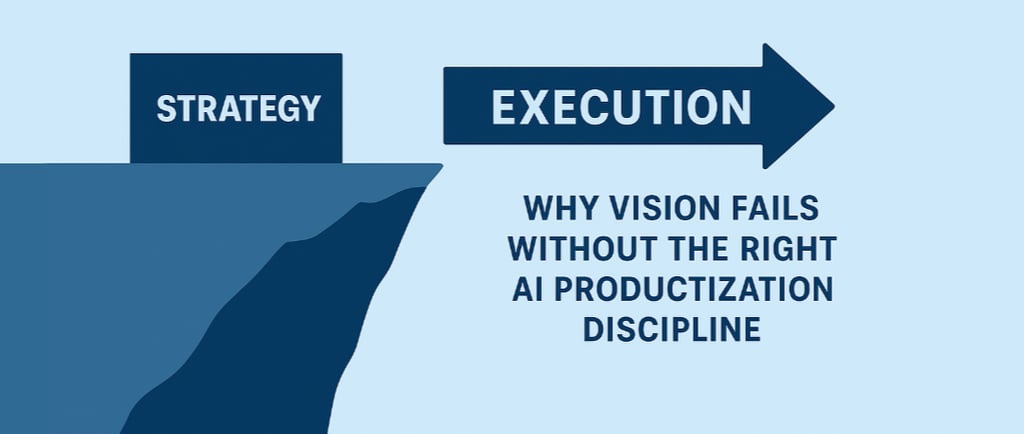
I’ve experienced it too many times in my career: a powerful vision, a bold roadmap - and then on the development floor, things sputter. Luckily, I also did experience fixing the Execution Challenge in various contexts as well as working in the environments where it wasn't a thing.
Talking about AI productization, this tension is magnified. Because when you’re building with LLMs, classical AI models, data, inference, feedback loops, deployment, monitoring - it only takes one weak link to put the whole project or product feature at risk.
🔎 Why Execution Problems are so Common
At executive and board levels, the natural reflex is “fix the strategy, rework the roadmap.” But often, the real issue lies deeper - in the execution layer, with poor translation, lack of discipline, or missing capabilities
The “vision-to-code” gap: what looks clean in a slide can break in practice. Interfaces, edge cases, dependencies, maintenance - these hidden costs are often under-budgeted or ignored
In AI, execution is riskier: pipelines break, data drifts, LLMs hallucinate, complex agentic patterns produce unpredictable results, models need retraining, feedback loops fail - any of those can collapse a project or product
The allure of AI exacerbates this: because models and demos look impressive, stakeholders often defer scrutiny of execution to “later.” But “later” is when the technical debt and fragility set in
💡 Tips to Strengthen Execution (with AI in mind)
Here are approaches I’ve used or observed that work:
1️⃣ Ensure core domain knowledge & seniority on teams
Don’t assume you can “learn on the go.” Teams need strong cores - people with domain experience, AI systems thinking, and architectural judgment
If that knowledge isn’t present, bring external expertise temporarily (consultants, contractors, partners) to complement internal skills
Over time, transfer knowledge to internal teams
2️⃣ Invest in training & upskilling
Stimulate the teams to follow hands-on training on the core areas - especially in the rapidly evolving GenAI field
Host internal (AI) "execution bootcamps” or sessions where engineers, product, ops co-learn common pitfalls (data pipelines, monitoring, error cases)
Encourage rotations or pairings (senior with junior) on critical areas (MLOps, deployment, performance, LLM-powered Agentic design patterns)
3️⃣ Decompose work into execution-safe slices
Rather than big monolithic AI features, break them into smaller deliverables that have independent value and can be tested incrementally
For example: first deliver a stable inference API, then add feedback loops, then add adaptability
4️⃣ Embed execution metrics into plans
For every roadmap item, assign measurable execution health metrics (pipeline reliability, error budgets, latency, drift alert counts)
Include “execution risk review” as part of planning and gating (not just feature proof-of-concept)
5️⃣ Feedback loops & instrumentation early
Don’t wait until “post-launch” - instrument logging, failures, performance, data drift, and user feedback from day one
Monitor and iterate rapidly
🔚 Final thought
Vision and strategy are essential - but in production systems with extra AI complexity, execution is often the defining battle. If you don’t build discipline, structure, and the right expertise at the execution layer, even the best strategies can stay as slides.
I’m curious - in your experience, what’s the single biggest execution failure you’ve seen in building production AI?
#AI #EnterpriseAI #Execution #ProductLeadership #BeyondThePilot